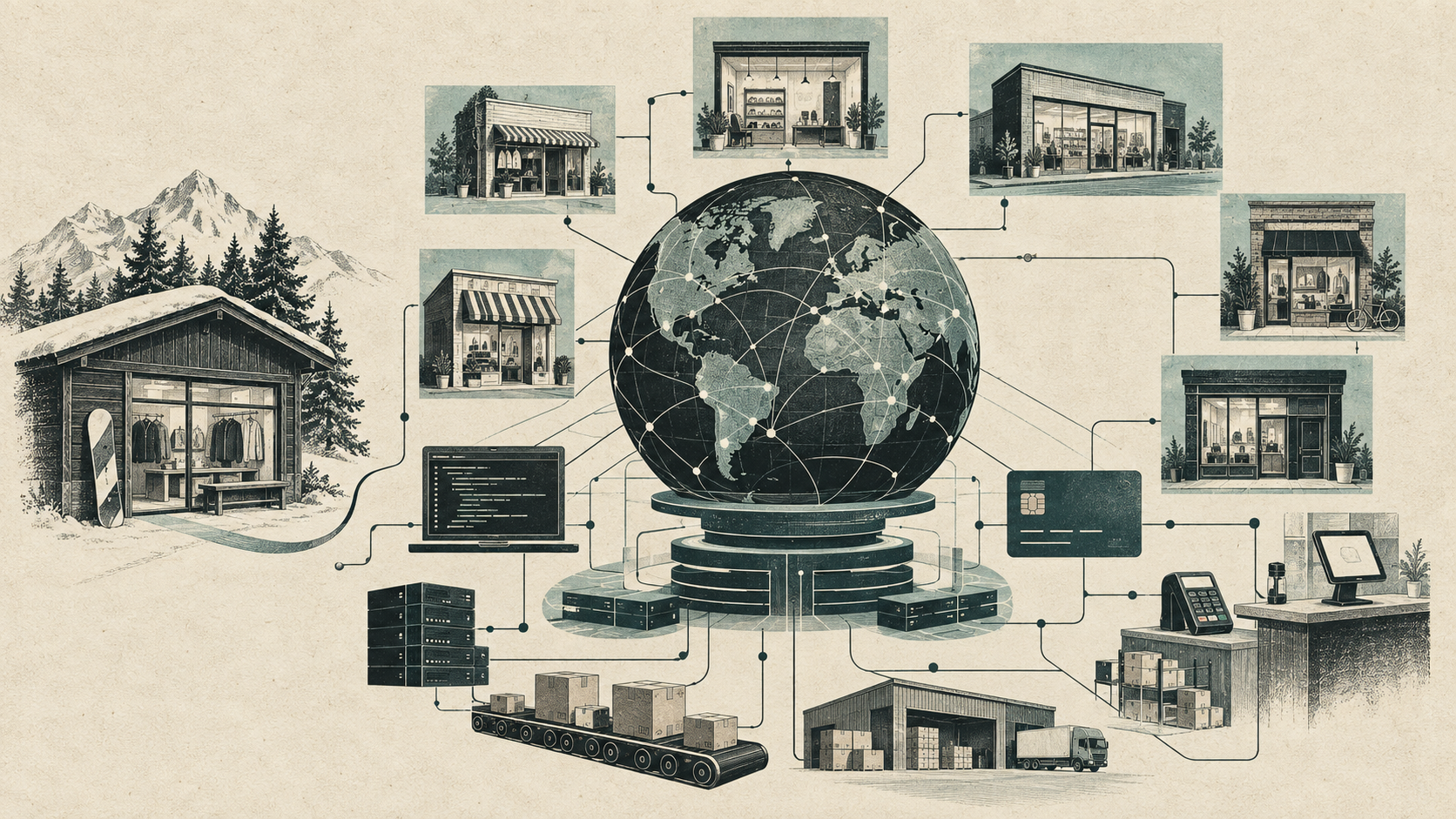
How Tobi Lütke turned a snowboard shop into the operating system for independent commerce
In the winter of 2004, Tobi Lütke was not trying to build a company that would sit between millions of merchants and their customers. He was trying to sell snowboards.
The distinction matters. Shopify’s founding story is often compressed into a clean startup parable: a programmer dislikes the available ecommerce software, writes his own, and discovers that the tool is more valuable than the store. That version is true, but it hides the mechanism. Lütke did not begin with an abstract thesis about “democratizing commerce.” He began as a merchant, met the software from the merchant’s side of the counter, and found that the available systems were organized around the needs of software vendors rather than the work of selling.
The product that became Shopify inherited that point of view. Its enduring strategic advantage was not that it could render a product page or accept a credit card. Competitors could do those things. Shopify made a series of decisions that preserved the merchant as the protagonist while the company expanded from a hosted store builder into payments, point of sale, shipping, capital, international commerce, enterprise infrastructure and a vast partner ecosystem.
Those decisions created tensions as well as growth. A platform that claims to arm independent merchants must still charge them. An ecosystem that invites partners will sometimes compete with them. A company that promises durable entrepreneurship made a pandemic-era bet on permanently elevated ecommerce, then laid off thousands when that bet failed. A founder who speaks about decentralized opportunity also secured unusual voting control. Shopify’s story is useful because it is not a myth of uninterrupted foresight. It is a record of choosing, learning, overreaching and returning to the core.
This is the story of a merchant’s machine: how it was built, why its architecture became a business model, where the philosophy held, where it bent, and what commerce operators can take from it now.
1. The child who found a computer
Tobias Lütke grew up in Koblenz, Germany, in a household far from the mythology of Silicon Valley. He has described himself as dyslexic and poorly served by a school system that rewarded a kind of learning that did not fit him. A computer changed the relationship. It offered a world whose rules could be inspected. If a program failed, the failure was not a judgment of character. It was a problem with a cause.
Programming became less a subject than a language for agency. The machine responded to precise instructions; mistakes produced feedback; systems could be taken apart and rebuilt. That loop would later shape Lütke’s management language. He tends to describe companies as systems, decisions as inputs and culture as the accumulated product of what a group rewards. In a 2011 Business of Software talk, he asked how founders might build businesses that people would not be embarrassed by in a hundred years. The phrasing was moral, but the method was engineering: inspect the system, identify the incentives, and redesign what produces bad outcomes.7
Germany’s apprenticeship system gave him another education. Rather than follow a conventional university route, he trained as a programmer. The practical bias mattered. Apprenticeship treats competence as something demonstrated through work, not declared through credentials. Shopify would later become known for testing candidates through practical exercises, giving technical craft unusual status and trying to separate demonstrated ability from résumé prestige.
Lütke moved to Canada in 2002, joining his future wife, Fiona McKean, in Ottawa. Immigration narrowed his immediate options. His German credentials did not automatically translate into a Canadian career, and his work authorization constrained employment. Entrepreneurship was not presented as glamorous escape. It was one route through a concrete problem.
He also snowboarded. Ottawa was not a natural center of snowboard retail, but the internet weakened geography. With Scott Lake, he decided to create an online shop called Snowdevil. The business idea was ordinary by later standards: source boards, build a site, reach customers. The infrastructure was not.
Early-2000s ecommerce software asked a merchant to become a systems integrator. Products, templates, orders, payments and hosting arrived as mismatched parts. The interfaces reflected database schemas. Design changes could threaten checkout. Software that was nominally made for small businesses often assumed that its operator was comfortable maintaining servers and editing code. The software sold the possibility of ecommerce while transferring the complexity to the merchant.
Lütke tried existing packages and hated them. In a 2010 interview, he said he had become burned out on programming until a friend pointed him toward Ruby on Rails, then a new web framework. He downloaded it, “fell in love,” and spent roughly two months building Snowdevil’s store software.4 Rails restored the feeling he had found as a child: a tool that made the system legible enough to change.
The important founding condition was now in place. Lütke was simultaneously the developer and the user. He could not hide behind a requirements document. Every awkward workflow returned to him as merchant labor. Every missing feature appeared not as a ticket but as an obstacle to a sale.
Operator’s note: The most useful founder-market fit is sometimes founder-workflow fit. Deep empathy does not require demographic resemblance to a customer. It requires direct exposure to the customer’s repeated work, with no organizational layer available to soften the pain.
2. Snowdevil’s real product
Snowdevil had a good 2004 season and turned a profit. By the usual logic, the team should have optimized the store: more inventory, better acquisition, broader distribution. Instead, the store revealed a more interesting asset. Other merchants and designers noticed the software beneath it. They wanted something like it for themselves.
The pivot was not simply “software scales better than snowboards.” Software businesses fail all the time, and retail businesses can scale. The deeper recognition was that Snowdevil’s hardest-won capability solved a problem shared by thousands of merchants. The team had learned more from building the selling system than from selling the product.
In Lütke’s later description, Shopify became the software he had hoped to find in 2004.4 That sentence contains a demanding product standard. It does not say “software that had more features.” It says the product had to erase the frustration that made a merchant build an alternative.
Lütke and Lake stopped treating the commerce engine as internal infrastructure and began turning it into a product. Daniel Weinand joined as a co-founder, bringing design sensibility to a company whose core risk was that technical power would again become merchant complexity. The first Shopify release took about a year and a half and arrived in 2006.4
That pace now sounds slow for a startup launch and fast for a commerce platform. Ecommerce is deceptively broad. A storefront is a public website, a content-management system, a product database, an inventory surface, a tax calculator, an order manager, a promotion engine, a payment workflow and a customer record. Each component has edge cases imposed by geography, products and human behavior. The founders were not building one feature. They were choosing how much of commerce could be represented in a coherent system.
The choice that followed was architectural and economic: Shopify would be hosted software. Merchants would not download a package, find a server, install updates and patch security flaws. They would subscribe to a service. This reduced the first sale for Shopify and the first technical burden for the merchant. It also gave Shopify a continuing obligation. The product could not be shipped and forgotten; it had to remain available through holiday peaks, browser changes, attacks and payment failures.
Hosted software aligned the feedback loop. Shopify’s revenue continued only if merchants continued. That alignment was imperfect, especially as merchant-solutions revenue later grew around transaction volume, but it was stronger than the old model of selling a license and leaving the operator with the consequences.
The founders bootstrapped by living cheaply. Lütke and his wife moved in with her parents. He and Lake went without salaries after launch. Savings, family help and Snowdevil’s profit extended the runway.4 Shopify became profitable in 2008, according to Lütke, before it embraced large venture rounds.4 This sequence influenced the company’s later self-image. Capital would be fuel, not proof that the engine worked.
There is a temptation to treat bootstrapping as virtue by itself. The lesson is more precise. Scarcity forced Shopify to locate a customer who would pay for the product as it existed. It prevented a long detour into a grand platform story before the basic merchant workflow worked.
Operator’s note: Before turning an internal tool into a product, identify the part outsiders are already pulling from you. Demand expressed as “Can I use that?” is more valuable than admiration expressed as “That looks impressive.”
3. The first principle: make the hard thing feel simple
Shopify’s early product philosophy can be summarized as a refusal to make the merchant carry the platform’s complexity. That does not mean commerce became simple. Tax remained complicated. Payments remained regulated. Inventory remained physical. Shipping still involved packages, addresses and carriers. Shopify’s job was to place complexity behind interfaces that preserved the merchant’s sense of control.
This is different from removing options. Bad simplification hides the few controls a serious operator needs. Good simplification finds the correct primitives. Products have variants. Orders have states. Themes separate content from presentation. Applications can extend the core without changing it. Once the primitives are right, a merchant can begin simply and grow into the system.
Lütke’s engineering background shaped that search. Programmers prize abstractions that are easy to use without destroying access to the underlying power. Shopify’s template language, Liquid, is one example. A merchant can choose a theme without writing code; a designer can modify presentation without rewriting the commerce engine; a developer can construct more specialized experiences. The same product supports different levels of skill.
That layering became a commercial advantage. Many small-business tools start easy and become restrictive. Many enterprise systems start powerful and remain punishing. Shopify tried to create a slope rather than a cliff: begin with a store, then add channels, apps, payments, international markets, wholesale or custom storefronts as the business requires.
The 2015 registration statement described a cloud platform that gave merchants a single view across web, mobile, social, pop-up and brick-and-mortar channels.1 By then, the language had expanded beyond “online store.” The conceptual unit was the merchant’s business. Channels were endpoints. Shopify wanted the catalog, inventory, order and customer record to remain coherent underneath them.
This merchant-centered architecture also affected design. The administrative interface was not an internal control panel grudgingly exposed to customers. It was the workplace. Every extra click multiplied across orders and employees. Every ambiguity became training cost. Every outage blocked revenue.
The philosophy sounds obvious after success. It was not obvious in a software culture that often treated small businesses as unsophisticated users who should accept whatever a vendor provided. Shopify treated a small merchant’s time as valuable. That respect appeared as product quality.
It also created a powerful internal test: does this help the merchant make a sale, fulfill it, understand the business or build a customer relationship? Not every Shopify initiative would pass cleanly. But the test gave the company a way to return from detours.
Operator’s note: Simplicity is not a visual style. It is an allocation of complexity. Write down who carries each hard part today. If the customer is repeatedly doing reconciliation, translation or repair that your system could own, that is product work disguised as customer work.
4. From product to platform
A hosted store builder can be a useful business. A platform can become an industry layer. Shopify crossed that line by deciding that it would not build every merchant capability itself.
Commerce varies too much. A merchant selling subscriptions has different needs from a furniture maker. A global apparel brand needs returns, duties and localized catalogs. A neighborhood bakery may need pickup slots. If Shopify attempted to place every vertical workflow in the core, the product would become slow, crowded and politically brittle. If it refused specialization, growing merchants would leave.
The answer was an ecosystem. Shopify exposed interfaces, created an app marketplace, and allowed outside developers to solve narrower problems. Designers built themes. Agencies implemented stores. Technology partners connected marketing, accounting, fulfillment and support. Shopify could keep the core coherent while the edges multiplied.
By 2022, Shopify reported more than 10,000 apps in its App Store and millions of merchants across more than 175 countries.3 Those figures show reach, but the operating consequence is more important. The platform converted merchant diversity from a roadmap burden into partner opportunity.
Ecosystems are often described as network effects, which can obscure the actual transaction. A merchant brings demand. A developer invests because demand is concentrated. The developer’s tool increases the platform’s usefulness. That attracts more merchants, including merchants with more specialized needs. Agencies reduce implementation friction. Successful merchants spend more on the surrounding stack.
But the arrangement requires governance. An app partner builds on land it does not own. Shopify controls discovery, technical permissions, billing rules and access to merchant data. It can enter a category that partners developed. It can change an API and impose migration work. Merchant-first decisions can conflict with partner economics.
Shopify’s durable move was not merely opening APIs. It was defining a boundary: the company would build shared infrastructure and invite a market around differentiated workflows. The boundary changed over time. Payments moved inward. Email marketing and fulfillment received more direct investment. Partners sometimes protested platform fees or overlapping products. Yet the ecosystem remained central because the alternative, a monolith that anticipated every merchant, was worse.
The platform model also changed Shopify’s distribution. Developers and agencies became sales channels without being a commissioned sales force. Each specialist who learned Shopify had an incentive to recommend it. Every theme tutorial and app integration lowered the cost of adoption for another merchant.
This is a subtle form of go-to-market. The company did not only acquire merchants. It increased the number of people whose livelihoods improved when Shopify won.
Operator’s note: A platform is not a product with an API. It is a product with a credible economic boundary. Partners invest when they can see where you will compete, how they reach customers, what access can change, and why the combined system is more valuable than either side alone.
5. The business model follows the merchant
Shopify’s revenue developed two engines. Subscription solutions charged merchants for access to the platform. Merchant solutions grew with the activity around a store: payments, transaction fees, shipping, capital and related services. The combination mattered.
Subscription revenue made the company care about merchant retention. Merchant-solutions revenue made it care about merchant success. A store that survived but sold little could keep paying a monthly fee; a store that sold more created more payment volume and service demand. Shopify’s economics increasingly rose with gross merchandise volume.
The 2015 filing shows the model at an important transition. Shopify reported approximately 162,000 merchants in 150 countries as of March 31, 2015. In 2014, merchants processed $3.8 billion in gross merchandise volume on the platform.1 The filing framed Shopify not as a website vendor but as a cloud commerce platform for small and medium businesses, already spanning online and offline channels.
Payments was especially consequential. Checkout is where merchant intent becomes money, and where failure is most expensive. By bringing payment processing into the platform, Shopify could reduce setup, observe conversion, manage risk and earn revenue as merchants transacted. The product became easier and the business became more aligned with volume.
There was a strategic cost. Payments exposes a company to fraud, chargebacks, regulation and underwriting. It also places the platform closer to the merchant’s cash flow. Decisions about reserves, account termination and acceptable use can determine whether a business operates. Merchant-first philosophy becomes harder when platform risk is real.
Shopify Capital extended the logic. If the platform can observe sales, it may underwrite financing differently from a bank looking at a thin credit file. Shipping labels turn aggregated merchant demand into negotiated logistics access. Point-of-sale hardware connects the same inventory and customer system to physical retail. Each service can be defended as removing a constraint that keeps a merchant from selling.
The sequence is instructive. Shopify did not begin by assembling a financial-services bundle and searching for distribution. It earned a place in the operating workflow, then added services adjacent to that workflow. Distribution came from product use.
The risk is attachment for its own sake. Once a platform can monetize every transaction, it may add services because the revenue pool is attractive rather than because the customer experience becomes better. The merchant test must remain stronger than the spreadsheet.
Operator’s note: The strongest expansion revenue often sits beside a workflow you already own. Before adding a service, ask whether your data, interface or aggregation actually improves the customer’s outcome. If not, adjacency is only a cross-sell.
6. Capital without surrendering the clock
Shopify raised venture capital after proving that merchants would pay and after reaching profitability. The sequence gave Lütke a different negotiating position. Money could accelerate an operating system already in motion rather than substitute for one.
The company raised $7 million in 2010, $15 million in 2011 and a much larger $100 million round in 2013, according to later profiles.8 Capital funded international growth, product development and the organization required to support a platform that merchants trusted with revenue. It also brought expectations that bootstrapping had postponed.
Lütke’s response was to define Shopify as a long-duration project. The company’s public writing repeatedly asks investors to judge decisions over years, not quarters. In his 2018 shareholder letter, he emphasized building for the long term and making commerce better for everyone, framing Shopify’s work as the infrastructure behind entrepreneurship rather than a finite market-share contest.2
Long-term language can become a shield for weak execution. The useful question is whether management spends short-term credibility on investments that deepen a coherent advantage. Shopify’s spending on APIs, internationalization, checkout and payments fit that test. Each made the platform more valuable to merchants and harder to replace.
The initial public offering in 2015 made the tension permanent. Public markets brought transparent metrics and daily pricing to a company whose founder wanted to think in decades. Shopify’s filing made the case through merchant outcomes: more merchants, higher GMV, more channels and a business model that expanded as merchants grew.1
Founder control became part of the answer. In 2022, shareholders approved a “founder share” that preserved Lütke’s voting influence under specified conditions. Supporters could argue that a durable mission required insulation from short-term pressure. Critics could argue that accountability weakened when economic ownership and voting power separated. Both can be true.
The operator lesson is not that founders should secure permanent control. It is that time horizon must be designed into governance and financing before pressure arrives. A leader cannot invoke patience only after missing a target. Long-term freedom is purchased through prior credibility, explicit rules and a record of using discretion well.
7. Arming the rebels
Shopify eventually found a narrative that expressed its strategy: Amazon was building an empire; Shopify armed the rebels.
The line worked because it turned an infrastructure company into a conflict readers could understand. Amazon aggregated consumers under one marketplace identity. Shopify supplied tools that allowed merchants to preserve their own brands, customer relationships and storefronts. One concentrated demand; the other distributed supply.
In a 2020 Financial Post profile, Lütke described Shopify as the rebel army to Amazon’s empire.8 The framing was competitive, but it was also a product doctrine. Shopify should become stronger without making the merchant disappear.
That doctrine explains why Shopify often resisted building a single marketplace that subordinated merchants to a Shopify-branded shelf. The Shop app and other buyer-facing products moved closer to discovery, but the company’s core claim remained that merchants owned their identities. Shopify’s best role was behind the transaction.
The rebel story should not be taken literally. Shopify is a large public company with substantial power over merchants and partners. A small business using Shopify is not independent of platforms; it is choosing a platform whose incentives may be more compatible with its own. Payments rules, app policies, theme architecture and search integrations still shape what the merchant can do.
Yet the distinction from a marketplace is operationally important. In a marketplace, the operator often owns demand and can change ranking, fees or access. The seller rents position. In Shopify’s model, the merchant usually brings or develops customer demand, chooses a presentation, and builds a direct relationship. Shopify monetizes the infrastructure.
This difference affects acquisition economics. Marketplace merchants may receive traffic but struggle to transfer the customer relationship elsewhere. Shopify merchants must earn traffic but can compound brand, email lists and customer data. The product does not remove the work of entrepreneurship. It makes more of the resulting asset belong to the entrepreneur.
For commerce operators, the rebel framing offers a useful positioning test. The best narratives map cleanly to product choices. If a positioning line cannot tell a product team what to prioritize or what to refuse, it is decoration.
8. The platform moves off the screen
Shopify began with online stores, but merchants do not experience channels as separate companies. They see one inventory problem, one customer, one cash position and one brand. The platform therefore moved into physical retail, social commerce and mobile management.
Point of sale was not a random adjacent market. A merchant who sells at a pop-up or permanent shop should not reconcile two catalogs and two order systems. A shared back office turns “omnichannel” from a consulting phrase into reduced labor.
This is a recurring Shopify pattern: take a capability that large retailers can fund through custom systems and make it available as shared infrastructure. Responsive storefronts, integrated payments, fraud tooling, local currencies, tax calculation and shipping rates all follow the pattern. The company pools technical investment across merchants.
The strategy also broadens the customer base upward. Shopify Plus, launched for larger merchants, tested whether the simplicity valued by small businesses could survive enterprise needs. Larger brands require permissions, integrations, international structures and contractual support. They also carry procurement habits that reward complexity because complexity justifies internal functions.
Shopify’s challenge was to add control without accepting the premise that enterprise software must be miserable. The strongest enterprise product is not the one with the most configuration. It is the one that gives complex organizations safe defaults and precise escape hatches.
Moving upmarket altered the company’s internal economics and partner network. Agencies could lead implementations. Systems integrators entered. The sales motion lengthened. Shopify gained larger GMV but risked orienting the roadmap toward customers with the loudest contracts rather than the broadest merchant need.
A platform serving both a first-time founder and a global brand needs a constitutional core. Catalog, checkout, orders, customers and extensibility must remain stable enough that additions do not split the product into unrelated editions. Shopify’s shared foundation became a source of speed: improvements to checkout or infrastructure could serve many segments.
Operator’s note: Going upmarket should add governance around the same job, not create an entirely different product. If the enterprise edition requires a second architecture, you may be entering a new business rather than extending the first.
9. Culture as production infrastructure
Lütke’s public conversations about culture are unusually technical. He speaks about talent density, learning rate, systems and the accumulated effects of decisions. This can sound clinical, but it reflects a founder who learned agency through software.
Shopify’s engineering culture elevated craft. Lütke contributed to open-source projects, including Ruby on Rails, and created tools such as Liquid and Active Merchant.7 Technical credibility mattered because developers were not merely an implementation department. The product was an abstraction over difficult systems; architecture was strategy.
The company also experimented with internal systems. Lütke’s 2011 talk described a peer-recognition mechanism into which Shopify put one percent of revenue, allowing colleagues to allocate points that translated into bonuses.7 Whether every mechanism endured is less important than the impulse: culture was something to make visible and improve, not a poster.
Remote work later became another system choice. During the pandemic, Shopify declared itself “digital by default,” rethinking offices around a distributed organization. The decision expanded recruiting and matched a company whose merchants operated globally. It also created coordination costs, weakened informal learning for some employees and forced managers to communicate more deliberately.
In 2023, Shopify removed large numbers of recurring meetings and introduced rules intended to protect focused work. The philosophy was consistent with Lütke’s programmer background: meetings are expensive interrupts; organizational process should justify its cost.
But companies are not codebases. People need context, belonging, apprenticeship and disagreement. A rule that protects one engineer’s concentration can remove another employee’s access to information. Systems thinking becomes dangerous when it treats emotion as noise rather than operational data.
Lütke’s statement that Shopify was a team, “not a family,” drew attention because it rejected a common corporate metaphor. The correction was useful: employment is conditional and companies should not exploit familial language to demand sacrifice. Yet a team metaphor can also become a justification for relentless selection. The ethical standard is not which metaphor sounds tougher. It is whether expectations, evaluation and consequences are clear before people pay the cost.
Shopify’s culture helped it move quickly and attracted people who wanted autonomy. It also produced public criticism around performance pressure and the human impact of layoffs. Both belong in the record. Culture is not what a founder intends. It is what the operating system repeatedly does to people.
Operator’s note: Treat culture as production infrastructure, but measure human consequences as outputs. A system that creates speed by hiding burnout, confusion or fear is borrowing performance from the future.
10. The pandemic bet
When COVID-19 closed stores and forced commerce online, Shopify became essential infrastructure almost overnight. Merchants who had treated ecommerce as a secondary channel needed a primary one. Restaurants added pickup. Local retailers built catalogs. Established brands accelerated direct sales.
Shopify’s growth surged. The company hired and invested for a future in which ecommerce’s jump would hold at a permanently elevated trajectory. Lütke later acknowledged that he made a bet: the share of retail moving online would advance by years and remain on that line.
The bet was wrong in its timing. Ecommerce remained structurally important, but consumer behavior normalized as stores reopened. Shopify had built an organization for a steeper curve. In July 2022, it announced a roughly 10 percent workforce reduction. In May 2023, it cut another 20 percent while selling most of its logistics business to Flexport.910
This period is important because it tests founder mythology. A narrative that credits Lütke for seeing the future must also assign responsibility when his forecast produced painful overexpansion. He did. In the layoff communication, he said the bet was his to make and he got it wrong. Accountability in words does not erase consequences, but refusing euphemism matters.
For operators, the error was not investing during a demand shock. Capacity had to expand. The error was allowing a plausible structural trend to harden into a single forecast. The faster conditions change, the more valuable reversible commitments become.
Headcount is not reversible in the human sense. Hiring signals a relationship and moves people’s lives. A company may be legally able to reverse it quickly, but the trust cost persists. Scenario planning should therefore treat organizational expansion differently from cloud capacity or marketing spend.
Shopify’s response also showed the advantage of a clear core. When the growth model failed, management could ask which work belonged to the main quest of making commerce better for merchants and which work had become a side quest. That language would become decisive in logistics.
Operator’s note: During a shock, separate direction from slope. A trend can be permanently true while the rate implied by an exceptional year is false. Build plans for at least three slopes, and label which commitments are expensive to reverse.
11. The logistics side quest
Amazon’s fulfillment advantage made logistics strategically tempting. If Shopify armed independent merchants but could not help them match delivery expectations, the platform’s promise had a physical limit.
Shopify invested in a fulfillment network, warehouse robotics and Deliverr. The 2022 Year in Review described an “asset-lite” port-to-porch logistics platform and noted the Deliverr acquisition among efforts to simplify shipping.3 In 2020 reporting, the company’s logistics ambition was presented as an equalizer for smaller businesses.8
The logic was coherent. The execution expanded Shopify’s operating surface into warehouses, routing and physical capacity, areas far from its software roots. Logistics has lower tolerance for elegant abstraction. Packages occupy space. Labor, leases, carrier contracts and regional density matter. A platform can write an API once and serve global users; a network must earn efficiency lane by lane.
In May 2023, Shopify agreed to sell most of the logistics business to Flexport. Lütke called logistics a worthwhile “side quest” that had helped create conditions for the main quest.10 Shopify received a larger equity interest in Flexport and made it a preferred logistics partner, preserving access without owning the whole operating burden.
It is possible to read the move as disciplined subtraction or as the reversal of an expensive strategic mistake. It was both. The company paid to learn that merchant logistics mattered but did not necessarily belong inside Shopify’s boundary.
This is one of the most transferable decisions in the story. Customer importance does not determine organizational ownership. A capability can be vital to the customer and still be better supplied by a partner. The platform’s job is to make the experience coherent, not to own every asset.
The critical question is comparative advantage. Shopify’s advantage lay in software, merchant distribution, checkout data and ecosystem orchestration. Flexport’s work lay in freight and logistics networks. The partnership could align those capabilities without forcing one company to become the other.
There is no glory in holding an initiative because abandoning it would expose the original judgment. Operators compound errors when identity becomes attached to scope.
Operator’s note: Map every strategic capability on two axes: importance to the customer and advantage in owning it. High importance does not imply high ownership. Integrate where you lack an advantage; own where control changes the customer outcome and you can operate the system distinctively.
12. What merchant-first really means
“Merchant-first” is easy to say because the merchant is an abstract hero. In practice, merchants disagree. A new seller wants easy onboarding. A large seller wants control. A partner wants stable economics. A buyer wants fast delivery and simple returns. A regulator wants accountability. Shopify itself must remain solvent and trusted.
Merchant-first therefore cannot mean granting every request. It means choosing the merchant’s durable ability to build a business as the reference point when incentives conflict.
Several Shopify decisions fit this definition. Hosted infrastructure removed server work. Themes and apps preserved specialization. Integrated payments reduced setup. Multichannel inventory reduced reconciliation. The ecosystem gave merchants choice. International tools made cross-border selling more accessible.
Other areas expose the limits. Payment risk controls can freeze funds. App-store terms can alter partner livelihoods. Subscription fees and payment charges accumulate. A merchant can own its brand while depending deeply on Shopify’s rules. Platform power does not disappear because it is exercised on behalf of entrepreneurs.
A credible merchant-first company needs procedural trust, not only benevolent intent. Policies should be legible. Appeals should exist. Data should be portable where feasible. Changes should provide enough notice for partners to adapt. The company should state where incentives diverge.
Shopify’s 2015 filing acknowledged dependence on merchant success and the risks of a complex partner ecosystem.1 That is not a moral guarantee, but it reveals the business alignment. If merchants fail broadly, the platform weakens. If merchants grow, Shopify’s payments and other merchant solutions grow with them.
The model is strongest when revenue follows value already created. It is weakest when switching costs allow the platform to extract more without improving the merchant outcome.
Operator’s note: Turn “customer-first” into governance. Define the conflicts that will occur, the metric that represents durable customer value, and the process for exceptions. Values become real where saying yes to one party means saying no to another.
13. The numbers tell a change in identity
Numbers are not the story, but they reveal which story became true.
In 2010, Lütke said Shopify served about 6,000 active merchants across more than 60 countries, whose stores had sold more than $100 million in the previous year. He said the company was profitable and generating revenue in the multiple millions.4
By March 2015, the IPO filing reported about 162,000 merchants in 150 countries. Merchants had processed $3.8 billion in GMV during 2014.1 Shopify had moved from promising tool to meaningful commerce layer.
By 2022, Shopify reported millions of merchants in more than 175 countries, $197 billion in annual GMV, $5.6 billion in revenue, monthly recurring revenue of $109 million, more than 10,000 apps and 11,600 employees.3 It also reported 561 million unique online shoppers buying from Shopify merchants during the year and approximately $28 billion in cross-border sales.3
Those figures should not be read as a straight line of triumph. The 11,600 employee figure preceded the 2023 reduction. The logistics initiatives celebrated in the report carried a note that most of the business would be sold to Flexport. A year-in-review document can contain the seeds of the next reversal.
The identity change is nevertheless clear. Subscription software became transaction infrastructure. An online-store builder became a system connecting merchants, developers, agencies, payment networks, carriers, social channels and buyers.
The most important business-model shift was the growing role of merchant solutions. Shopify no longer succeeded only when it signed a merchant. It succeeded when the merchant transacted. That alignment supported investment in checkout, payments and other services, while also giving Shopify greater influence over the flow of commerce.
Scale changes moral and operational stakes. An outage at a small software company is an inconvenience. An outage across a large commerce platform can prevent thousands of businesses from earning revenue. Reliability becomes part of the merchant-first promise.
14. The decisions that compounded
Shopify’s history contains dozens of launches, acquisitions and reorganizations. A smaller set of decisions did most of the compounding.
Build from the merchant’s seat
Snowdevil made the founders users of their own infrastructure. The merchant’s labor was visible. The product began with a concrete standard: it should be the software they wished had existed.
Host the complexity
Software as a service shifted installation, security and updates away from merchants. The recurring model aligned Shopify with continuing usefulness and gave the company a direct feedback loop.
Design the core for extension
Liquid, APIs, themes and apps allowed specialists to serve varied merchants without turning the core into a maze. The ecosystem multiplied product surface and distribution.
Pair subscription with merchant success
Payments and other merchant solutions made Shopify’s revenue respond to commerce volume. The company’s economic attention moved from acquisition alone to merchant growth.
Preserve merchant identity
Shopify resisted becoming a marketplace in which its brand erased the seller. That position differentiated it from Amazon and gave merchants a reason to build long-term assets on the platform.
Move across channels while keeping one back office
Point of sale, mobile and social integrations treated channels as expressions of one merchant system. The administrative foundation remained the product.
Spend credibility on long-term infrastructure
Public-company pressure did not stop Shopify from investing in checkout, internationalization and ecosystem capacity. Founder control and long-term framing extended the decision horizon, though they also raised accountability questions.
Admit when ownership was wrong
The pandemic hiring reversal and logistics sale were costly. The decision to shrink and partner prevented sunk costs from becoming a permanent strategy.
A decision compounds when it improves several future decisions. Extension architecture reduces roadmap pressure, creates partner distribution and increases merchant fit. Integrated payments simplify onboarding, improve conversion data and align revenue with GMV. These are more powerful than isolated features because they alter the company’s option set.
15. The contradictions operators should keep
Founder stories are most useful when contradictions remain visible.
Shopify celebrates entrepreneurship but is itself a gatekeeper. It distributes commerce power but centralizes platform rules. It invites partners but may enter their categories. It argues for patience while public investors absorb volatility. It prizes talent density while layoffs impose costs on people recruited under a different growth plan. It champions merchant independence while merchants rely on its payments and infrastructure.
These tensions do not invalidate the strategy. They define the work.
The strongest organizations do not resolve every contradiction. They build mechanisms to manage them. Platform governance manages core versus ecosystem. Financing and voting rules manage long-term investment versus accountability. Product architecture manages simplicity versus control. Partnerships manage customer importance versus ownership.
Operators should distrust stories in which the founder’s values naturally produce good outcomes. Values collide. Merchant simplicity can conflict with developer flexibility. Fraud prevention can conflict with access. Speed can conflict with deliberation. Talent density can conflict with psychological safety.
The transferable skill is not conviction alone. It is making the trade-off explicit, choosing, observing the result and remaining willing to revise the boundary.
16. A practical playbook for commerce operators
Start with work, not market language
Describe the customer’s repeated tasks in verbs. Source, list, price, sell, collect, fulfill, return, reconcile, learn. Market categories become clearer after the work is visible.
Find the complexity your customer is subsidizing
Every manual spreadsheet, duplicate entry and support workaround is an unpaid contribution to your product. Decide which burden should move into the system.
Choose primitives that survive scale
A good primitive serves the first customer and the thousandth without forcing the product into separate worlds. Shopify’s products, variants, orders, themes and apps were durable because they represented stable parts of commerce.
Build the ecosystem boundary before the ecosystem pitch
Write down what the core owns, what partners can own, how they reach customers, and what happens when the platform enters an adjacent category. Ambiguity taxes partner investment.
Align expansion revenue with customer progress
Prefer revenue that rises when the customer gets more value. Watch for cases where switching costs, opacity or control allow monetization without progress.
Use narrative as a decision filter
“Arm the rebels” was useful because it implied preserving merchant identity. A narrative should help teams refuse tempting work that contradicts the model.
Separate vital from owned
Make a list of capabilities critical to the customer. Then independently decide which the company must own. Partnerships are often the best product decision when control does not create differentiated value.
Plan shocks with reversible commitments
Do not turn one exceptional year into one forecast. Model slopes. Mark commitments by reversal cost. Treat hiring as a human commitment, not a variable expense.
Audit culture as a system
Look at promotion, meeting load, information access, performance management and exits. Those mechanisms reveal culture more accurately than principles pages.
Preserve the ability to return to the core
A clear mission is not only inspirational. It is a recovery mechanism. When an expansion fails, teams need a shared test for what remains.
17. The machine and the merchant
Shopify’s deepest contribution to commerce was not inventing the online store. It was changing who could operate one and how far that operator could grow before rebuilding the business on different infrastructure.
The company did this through a sequence of allocations. It moved server complexity from merchant to platform. It moved specialized development from core roadmap to ecosystem. It moved payments setup into the product. It moved multi-channel reconciliation into one back office. It moved some logistics ambition back out to a partner when ownership stopped making sense.
Lütke’s founder story is therefore less about seeing a giant market than about respecting a small task. The original merchant wanted software that did not fight him. Each stage of Shopify’s growth can be judged against that standard.
The standard did not prevent mistakes. It did not eliminate platform power or guarantee fair outcomes. It did give Shopify a durable point of view: entrepreneurship should be easier to begin, more coherent to operate and less dependent on surrendering the merchant’s identity to a marketplace.
That point of view arrived at the right historical moment. Cloud software reduced deployment cost. Social networks and search distributed demand. Payments APIs improved. Direct-to-consumer brands gained cultural energy. Smartphones blurred online and offline retail. Shopify assembled these shifts into a system merchants could use.
The next commerce stack will be shaped by another set of shifts: agents that research and buy, richer product data, programmable payments, automated operations and networks that need to distinguish verified merchants and offers from noise. The operator’s job remains familiar. Decide where trust lives. Decide who owns the customer relationship. Decide which complexity the system should absorb and which choice the merchant should retain.
Commerce Stories is published by the team behind Commerce Index. Stories explain how commerce works; Commerce Index is building infrastructure for what comes next.
If Shopify’s lesson is to begin with the merchant’s real work, the practical next step is to map your own operator’s stack. List the systems that hold product truth, merchant identity, offers, inventory, payments, fulfillment and customer context. Mark the handoffs that still require copying, reconciliation or blind trust. Those gaps are where the next platform decision is already waiting.
Commerce Index is being built as that working layer: a place where merchants, verified offers and buying agents can find one another without erasing the merchant behind the transaction. The story ends there because the operating work begins there.
Sources
- Shopify, Form F-1 registration statement, filed 14 April 2015. https://www.sec.gov/Archives/edgar/data/1594805/000119312515129273/d863202df1.htm
- Tobi Lütke, “2018 Letter from Tobi,” Shopify Investor Relations. https://investors.shopify.com/past-letters/2018-letter/default.aspx
- Shopify, “2022 Year in Review,” filed as an SEC exhibit. https://www.sec.gov/Archives/edgar/data/1594805/000159480523000029/a2022yir.htm
- “Q&A with Tobias Lütke of Shopify,” Signal v. Noise, 2 September 2010. https://signalvnoise.com/posts/2378-qa-with-tobias-ltke-of-shopify
- “Shopify: Tobias Lütke,” How I Built This, NPR, 2 August 2019. https://www.npr.org/2019/08/02/747660923/shopify-tobias-l-tke
- “Tobi Lütke on Creating Shopify for Americans as a German in Canada,” Conversations with Tyler, 4 September 2024. https://conversationswithtyler.com/episodes/tobi-lutke/
- Tobias Lütke, “How to make sure your business is on the right side of history through code & culture,” Business of Software, 2011. https://businessofsoftware.org/talks/ceo-shopify-how-we-can-build-businesses-that-people-in-100-years-wont-be-embarrassed-by/
- Joe O’Connor, “‘We’re the rebel army to Amazon’s web empire’: Shopify’s Tobias Lütke,” Financial Post, 30 October 2020. https://financialpost.com/technology/shopifys-tobias-lutke
- Sarah Jackson, “Shopify is cutting 20% of staff and selling the logistics arm of its business,” Business Insider, 4 May 2023. https://www.businessinsider.com/shopify-lays-off-20-percent-staff-sells-flexport-logistics-business-2023-5
- Dani James, “Shopify reports $1.5B in revenue, lays off 20% of workforce,” Retail Dive, 4 May 2023. https://www.retaildive.com/news/shopify-lays-off-20-percent-workforce/649444/
18. Decision case study: why the admin mattered more than the storefront
Ecommerce products are judged first by the visible store. The homepage, collection grid and product page are where a brand performs. But a merchant spends much of the working day somewhere less photogenic: the administrative back office.
That is where a platform reveals whom it respects. An attractive storefront can win a demo while a poor order screen extracts time from every transaction. A flexible theme can attract a designer while inconsistent inventory creates refunds. Shopify’s early advantage was to treat the admin as the primary product surface and the storefront as an output of the merchant’s choices.
This ordering had several effects. First, it rewarded clarity over spectacle. The admin had to explain the state of the business. Orders needed statuses that operators could understand. Products and variants needed a model that matched how merchants stocked goods. The system had to expose enough information for action without requiring database knowledge.
Second, the back office became the point from which Shopify could add channels. If catalog and inventory were trapped inside a web storefront, physical retail or social selling would require separate systems. If they lived in a shared administrative core, new channels could consume the same truth.
Third, the admin created habit. Storefront setup may be occasional; order management is daily. Daily use produces feedback, switching cost and trust. It gives the platform a view of friction that a website builder does not possess.
This pattern appears across strong vertical software. The glamorous surface attracts attention, but the record system creates durability. Operators choosing where to invest should ask which interface holds the customer’s recurring truth. That surface often deserves the best product talent, even if it never appears in an advertisement.
19. Decision case study: Liquid as organizational strategy
Liquid, Shopify’s template language, can be understood as a technical artifact. It is also a governance choice.
A template system divides responsibility. Shopify controls the commerce engine and provides objects representing products, collections, carts and customer information. Designers control presentation within safe boundaries. Merchants gain variety without receiving a completely different application each time.
This separation reduced coordination costs. Shopify did not need to approve every visual idea. Designers did not need access to the core codebase. Merchants could change themes while preserving catalog and orders. A technical boundary created an economic market.
The language was deliberately constrained. Constraint can feel like lost power, but it protects portability and security. If every theme could alter every system behavior, theme choice would become a platform migration. By deciding what presentation could see and change, Shopify made themes exchangeable.
This is a general platform lesson. Extensibility is valuable when it preserves the integrity of the core. Unlimited customization can turn a product into consulting substrate, leaving every customer on a unique fork. The goal is not maximum freedom. It is useful freedom at a stable boundary.
For an operator, the question is: where can outsiders create differentiated value without threatening system coherence? The answer may be a template language, an API, a plug-in model, a data export or an event stream. The design of that boundary is business-model work.
20. Decision case study: payments becomes product
Payments sits at the intersection of software promise and commercial reality. A store can look finished while remaining unable to collect money. Early merchants often had to create a separate processor account, pass underwriting, find credentials and connect the pieces. Each step created abandonment and support work.
Shopify Payments changed the setup experience by bringing payment acceptance into the product. This was not merely a bundle. It allowed checkout, risk, reporting and payout information to exist in one operating context.
The strategic gains accumulated. Activation improved because one major dependency disappeared. Shopify received richer information about transaction performance. Support could see more of the failure path. Product teams could optimize checkout with a direct economic feedback loop. Revenue increased with payment volume.
The responsibility accumulated too. Payment platforms decide whose transactions are acceptable. Fraud losses require controls. Reserves and holds can starve a small merchant of cash. The platform must satisfy financial rules that may not map cleanly to a merchant’s story.
Bringing an adjacent service into the core is therefore a trade: less customer coordination in exchange for more company accountability. Operators should make that trade only when they are prepared to own the ugly exceptions, not merely the attractive revenue.
21. Decision case study: the app ecosystem’s fragile bargain
For merchants, the Shopify App Store can make the platform feel infinitely adaptable. For developers, it offers distribution into a concentrated commercial audience. For Shopify, it externalizes specialization. The bargain works when all three sides believe the rules permit durable investment.
Discovery is one pressure point. If rankings determine demand, changes to ranking logic redistribute developer revenue. Billing is another. Platform fees affect what kinds of applications can exist. Data permissions determine both product usefulness and privacy risk. Native Shopify features can make a partner category obsolete.
No platform can promise never to compete with a partner. Customer needs change, and some functions become foundational. But a platform can explain the principles that govern entry: security, shared infrastructure, quality baseline, or a need that is universal enough to belong in the core.
Partners also owe the platform discipline. Poor applications can slow stores, misuse data or create support burdens that merchants attribute to Shopify. Review and enforcement protect the ecosystem’s shared reputation.
The bargain is fragile because the platform can usually survive the failure of one developer while a developer may not survive the platform’s decision. That asymmetry creates a higher duty of notice and procedural fairness for the platform.
Operators building ecosystems should track partner trust as a leading indicator. Revenue and app counts are lagging measures. Migration complaints, surprise policy changes, support latency and declining willingness to build reveal the health of the bargain earlier.
22. Decision case study: why Shopify Plus did not require abandoning small merchants
Moving upmarket often creates an internal prestige gradient. Large accounts receive dedicated sales attention, executive access and visible revenue. The original small customer can become rhetorically important and operationally secondary.
Shopify Plus offered enterprise capabilities while relying on much of the same platform foundation. That shared core was protective. Improvements demanded by large merchants could benefit the broader base when expressed as infrastructure rather than one-off customization. Checkout scale, permissions and international operations could strengthen the system.
The danger was feature capture. Enterprise customers often ask for exceptions based on existing process. Fulfilling every exception recreates legacy software and slows the platform. Shopify’s product discipline depended on translating large-customer needs into primitives useful across merchants.
The model also changed distribution. Agencies and systems integrators could implement complex stores, allowing Shopify to benefit from enterprise demand without carrying every service role. Again, architecture and ecosystem worked together.
The operator lesson is to separate customer size from product truth. A large contract is strong evidence of willingness to pay, not automatic evidence that the requested workflow belongs in the core. Build the capability when it represents a broader class of need. Use partners or configuration when it is specific. Decline it when it would deform the system.
23. Decision case study: international commerce is translation plus infrastructure
Selling internationally looks like a localization problem. It is actually a coordination problem across currency, language, duties, taxes, payments, shipping, domains and customer expectations.
A small merchant cannot efficiently assemble specialists for every market. A platform can pool the investment. Shopify’s expansion into localized pricing, payments, shipping and Markets products applied the same logic as the original hosted store: move shared complexity away from the merchant.
The 2022 report said nearly 28 percent of traffic to Shopify merchants came from outside a merchant’s home country and approximately $28 billion in cross-border sales occurred that year.3 Those numbers show that international demand was not an edge case.
But international tools can create false confidence. Translating a storefront does not establish local demand. Currency display does not solve returns. Automated duties do not fix delivery reliability. Regulation and consumer rights vary. The product should reveal these differences rather than hide them.
For operators, international expansion should begin with an evidence ladder. Observe cross-border traffic and orders. Identify markets where demand persists despite friction. Remove the largest shared constraint. Then localize acquisition and operations. Platform tooling reduces friction; it does not replace market fit.
24. Decision case study: direct relationships versus aggregated demand
Marketplaces solve the cold-start problem by aggregating buyers. A new seller can list where demand already exists. The cost is dependence on ranking, fees and marketplace identity.
Shopify solves a different problem. It gives the merchant a place to convert demand and retain a direct operating relationship. The cost is that the merchant must generate attention.
Neither model is universally superior. A marketplace can be ideal for discovery, liquidity and trust. A direct store can be better for differentiation, retention and control. Many merchants use both.
Shopify’s strategic position was to become the system of record across those channels rather than demand that merchants choose ideological purity. Social integrations and marketplace connections could feed the same catalog and orders. The merchant could rent demand while building owned assets.
This offers a practical portfolio model for operators. Classify channels as rented, partnered or owned. Rented channels deliver demand under another party’s rules. Partnered channels share access and economics. Owned channels preserve the closest customer relationship. Measure not only immediate conversion but what remains after the transaction: permission, data, recognition and repeatability.
25. Decision case study: Shop and the danger of becoming the thing you oppose
A buyer-facing product can improve the merchant experience. Order tracking, accelerated checkout and discovery reduce friction. But the closer Shopify moves toward a unified consumer destination, the more it risks recreating the marketplace power it differentiated against.
Shop is therefore a strategic balancing act. It can aggregate utility without aggregating merchant identity. It can help a buyer discover and return while keeping the merchant visible. Or it can gradually make the platform brand primary and merchants interchangeable.
The right product test is not whether consumers engage. It is whether engagement increases the merchant’s durable customer relationship. A high-retention consumer surface could still weaken merchant control if messages, rankings or data become platform property.
This is a classic adjacency trap. The platform sees aggregate demand and imagines a larger profit pool. The opportunity is real. So is the possibility that capturing it undermines the reason suppliers chose the platform.
Operators should define red lines before building buyer aggregation. Which identity appears first? Who can contact the buyer? How are recommendations ranked? Can a merchant export the relationship? What fee changes become possible? Answers determine whether aggregation is infrastructure or enclosure.
26. Decision case study: founder control and earned patience
Lütke’s voting influence reflects a belief that Shopify’s mission benefits from stable founder direction. The argument is familiar in technology: markets can punish investment whose returns sit beyond the next reporting cycle, while a founder can preserve product coherence.
The counterargument is also familiar. Control can reduce the mechanisms that correct a founder when conviction becomes error. Shopify’s pandemic hiring bet and logistics expansion show that a long horizon does not guarantee a correct forecast.
The useful distinction is between independence and impunity. Independence gives a leader room to make non-consensus investments. Impunity removes the consequences of poor judgment. Good governance seeks the first without producing the second.
Boards, disclosure, explicit control conditions and credible performance measures can narrow the gap. So can a culture in which leaders name their errors and reverse strategy. None is a full substitute for shareholder power, but each affects whether control produces stewardship or entrenchment.
Operators without dual-class shares face the same underlying issue at smaller scale. Who can stop the founder? Which metrics challenge the favored narrative? What evidence triggers review? Decision rights should be paired with disconfirming mechanisms.
27. Decision case study: subtraction as strategy
Companies celebrate launches and hide removals. Yet subtraction is often the more difficult strategic act.
Selling the logistics business reduced Shopify’s scope while preserving a partner relationship and equity interest. Removing recurring meetings reduced process. Workforce reductions reduced cost and capacity, though with severe human consequences. Each action reflected a judgment that more was no longer better.
Subtraction creates clarity only when the remaining mission becomes sharper. Random cuts distribute pain and leave the system incoherent. Strategic subtraction identifies what the company will become more capable of doing because it stopped something else.
Lütke’s “main quest” language worked because employees and investors could connect it to Shopify’s long-standing purpose. The metaphor did not eliminate the damage of layoffs, but it supplied a decision boundary.
Operators should maintain a stop list alongside a roadmap. For every initiative, record the hypothesis, review date and evidence that would cause exit. This protects the organization from turning persistence into identity.
28. A timeline of the operating system
2004: Lütke and Scott Lake build Snowdevil in Ottawa. Dissatisfied with ecommerce packages, Lütke writes the store software in Ruby on Rails.4
2006: Shopify launches as a hosted ecommerce product after roughly a year and a half of development.4
2008: Shopify reaches profitability, according to Lütke’s later account.4
2010: Shopify reports about 6,000 active merchants in more than 60 countries and more than $100 million in merchant sales over the prior year. It raises a $7 million venture round.48
2011: The company raises another $15 million. Lütke publicly describes culture and long-term corporate responsibility in his Business of Software talk.78
2013: Shopify raises $100 million, accelerating the transition from useful software company to major commerce platform.8
2015: Shopify files to go public. The F-1 reports approximately 162,000 merchants and $3.8 billion in 2014 GMV.1
2016 onward: Shopify deepens payments, point of sale, shipping, capital and enterprise capabilities while the app and agency ecosystem expands.
2018: Lütke’s shareholder letter reinforces the long-term mission and broad ambition to make commerce better.2
2019-2020: Shopify expands fulfillment ambitions. Pandemic conditions drive a rapid shift to online commerce. The company declares a digital-by-default future for work.
2022: Shopify reports $197 billion in GMV, $5.6 billion in revenue, millions of merchants in more than 175 countries and more than 10,000 apps. It also announces a workforce reduction after the pandemic demand forecast proves too steep.3
2023: Shopify sells most of its logistics business to Flexport and reduces the workforce by another 20 percent, returning focus to the core platform.910
The timeline shows that Shopify did not become a platform through one pivot. The snowboard-to-software decision created the product. Hosting created the recurring relationship. APIs and partners created variety. Payments tied economics to volume. Channels expanded the system. Logistics tested the boundary. Subtraction clarified it.
29. Metric glossary for reading Shopify
Merchant count indicates distribution, but definitions matter. A paying store is not the same as a successful business, and one merchant may operate multiple stores.
Gross merchandise volume is the value of orders processed through the platform and certain connected channels, net of refunds and including specified shipping, duty and taxes under Shopify’s definition.3 GMV measures economic activity, not Shopify revenue.
Monthly recurring revenue multiplies merchants by average subscription plan fee at period end under the company’s definition.3 It gives a directional view of subscription revenue but does not capture every expansion service.
Subscription solutions revenue reflects access to the platform and related subscription products. It is closer to classic SaaS economics.
Merchant solutions revenue includes services that tend to vary with merchant activity, such as payments and other transaction-linked products. Its growth reflects both adoption and commerce volume.
Gross payment volume measures GMV processed through Shopify Payments. It helps show how much of the platform’s commerce flow passes through the integrated financial layer.
App count shows ecosystem breadth but not quality, concentration or partner economics. Thousands of apps can still leave important workflows poorly served.
Unique shoppers measures reach across merchant stores, not a unified Shopify marketplace audience in the conventional sense.
Operators should read these measures as a system. Merchant count without GMV can signal low activation. GMV without strong subscription retention may depend on a narrow group of stores. Merchant-solutions growth without healthy merchant economics can become extraction. No single number proves merchant success.
30. Questions for an operator’s offsite
- What customer work did our company originally understand better than anyone else?
- Which parts of that advantage remain present in the product, and which survive only in the founding story?
- Where are customers manually carrying complexity that our system could absorb?
- Which abstractions in our product have survived growth? Which now block it?
- What belongs in the core, what belongs with partners and what should remain the customer’s choice?
- Does expansion revenue rise because customers make progress, or because leaving is difficult?
- Which channel gives us demand but weakens the customer relationship?
- Which channel compounds an owned relationship?
- Where does our positioning line constrain product decisions?
- What initiative would we stop if we were not protecting the original decision?
- Which current commitment is hardest to reverse, and what forecast supports it?
- What evidence would prove that forecast wrong?
- Whose livelihood changes when we alter a policy, API or ranking?
- What notice and appeal do those people receive?
- Which important customer capability are we poorly equipped to own?
- What partner could provide it better without breaking the experience?
- How does our governance create patience? How does it preserve correction?
- What does our culture repeatedly reward in practice?
- Which metric represents durable customer value rather than activity?
- If conditions change suddenly, what is our main quest?
These questions turn the founder story into management work. The point is not to imitate Shopify’s products. It is to inspect the decisions beneath them.
31. Source notes and limits
This account relies most heavily on Shopify’s 2015 registration statement for the pre-IPO business model and metrics; the 2022 Year in Review for later scale and product activity; Lütke’s 2010 interview for the Snowdevil origin and bootstrapping details; his 2011 Business of Software talk for his early ideas about corporate responsibility and culture; later interviews for his evolving management views; and independent reporting for the logistics sale and workforce reductions.
Company filings are strong for definitions and disclosed figures but are advocacy documents as well as legal records. Founder interviews are strong for intent and sequence but naturally organize events around the founder’s memory. Reported profiles add observation and counterpoint, though access can also shape tone. Coverage of layoffs records immediate impact but cannot fully represent every employee experience.
Where figures refer to a particular year, they are labeled with that period rather than treated as current. This story is about the development of Shopify’s operating system, not a current investment recommendation. It does not attempt to catalogue every acquisition, policy controversy or product launch.
The most reliable conclusion is not that every Shopify choice worked. It is that a small set of coherent choices created a platform able to learn from a very large and varied merchant base. The failures are part of that conclusion because they show where coherence ended.